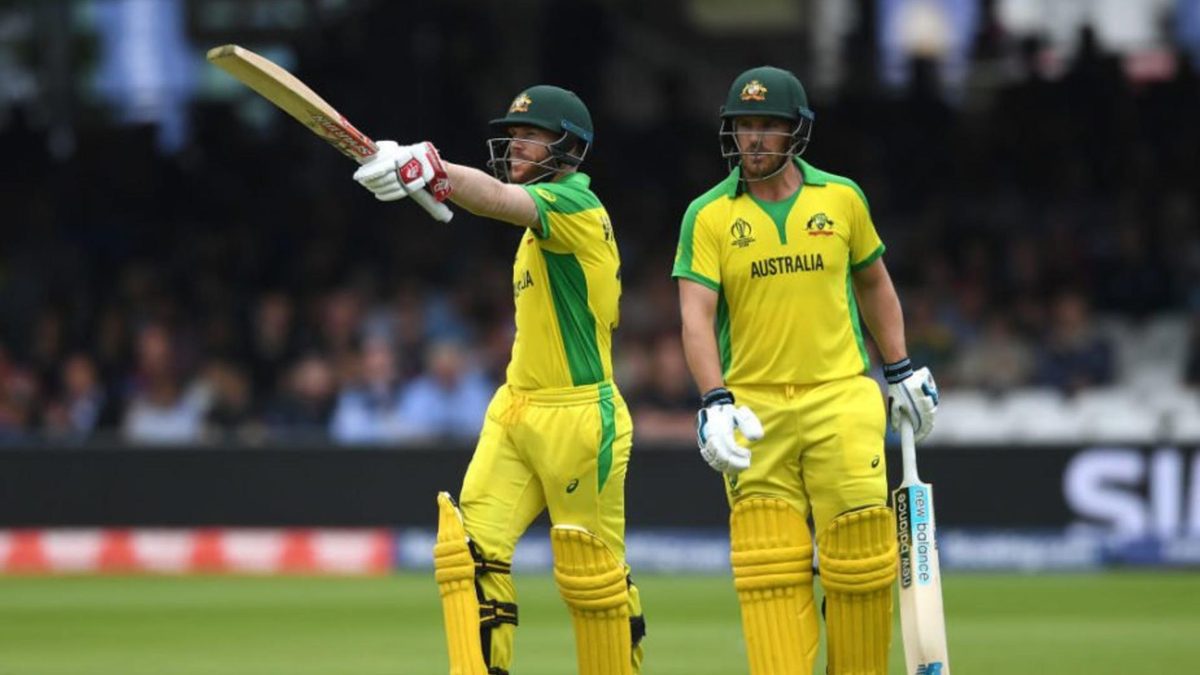
Aaron Finch and David Warner have become the first opening partnership to score five successive half-century partnerships at a single World Cup.
After a lively start at Lord’s that included sharp half-chances for Joe Root at slip and James Vince at backward-point, Australia’s opening duo weathered the early storm and went on to post their fifth successive 50-plus opening partnership in this tournament, breaking a record that had been equalled but never surpassed since it was set in the 1983 tournament.
After notching 61 for the first wicket against India – Australia’s sole defeat of the campaign thus far – Warner and Finch have posted four further successive half-century opening stands, impressively converting three of them into century stands with totals of 146 versus Pakistan, 80 versus Sri Lanka, 121 versus Bangladesh and 123 today at Lord’s.
Century for Aaron Finch and Australia now have 15 overs to push their score beyond 300 with Maxwell, Stoinis, Carey and Cummins all to come. Glenn Maxwell’s CWC SR so far is 209.67 #ENGvAUS #CWC19 pic.twitter.com/dNLaGmHVwi
— Wisden (@WisdenCricket) June 25, 2019
, just moments after the century stand had been brought up, chipping a Moeen Ali delivery high off the bat to Root, but as has regularly been the case – in each of Australia’s last four games one of the duo has made a century – Aaron Finch remained to reach triple figures and set the Australian platform for late-order hitting from Glenn Maxwell and Alex Carey.
Immediately after reaching the milestone, Finch miscued a Jofra Archer bumper and departed for exactly 100, just four runs short of equalling his opening partner on 500 runs at the top of the World Cup run-scoring charts.
Fellow Aussie openers David Boon and Geoff Marsh (1983) and Adam Gilchrist and Matthew Hayden (2003) are among the duos who have previously registered four successive 50-plus opening stands in Cricket World Cups.
The full list of four or more successive half-century stands in the Cricket World Cup:
- Aaron Finch and David Warner (Australia, 2019, 5 successive half-century stands)
- Adam Gilchrist and Matthew Hayden (Australia, 2003, 4)
- Amar Sohail and Saeed Anwal (Pakistan, 1996, 4)
- Chris Tavare and Graeme Fowler (England, 1983, 4)
- David Boon and Geoff Marsh (Australia, 1983, 4)