Modern cricket has made careers longer, but has it changed how players age? Sarah Waris evaluates Test cricketers aged 35 and above since 2000 and explains how batting and bowling have followed very different paths.
Age has long been regarded as one of the biggest barriers in elite sport. As athletes move into their mid-30s, physical decline is expected to outweigh experience, as careers gradually come to an end. Modern sports, including cricket, however, seem to challenge that idea. Several of the game’s biggest names continue to play central roles well beyond 35, fuelling the belief that advances in fitness, recovery and workload management have extended not only careers, but also players' prime years.
Modern cricketers undoubtedly enjoy advantages that previous generations did not. Tailored fitness programmes, sports science, nutrition and carefully managed workloads have all become integral to the professional game. Bilateral schedules have also become more flexible, allowing players to skip formats or individual series to prolong their careers. The assumption, therefore, is simple: if players are staying around for longer, they must also be staying at their best for longer.
We analysed Test cricketers from the first 10 Full Member nations (excluding Afghanistan and Ireland) across two periods, 2000-2015 and 2020 onwards. Only players who featured in at least 20 Tests after turning 35 were included, ensuring the sample reflected established careers rather than brief appearances.
Between 2000 and 2015, 51 cricketers played at least 20 international matches after turning 35, an average of 3.2 players a year. Since 2020, that figure already stands at 42, or around 6.5 players a year. In Tests, however, the picture is less convincing. Twenty-five players featured in at least 20 Tests after turning 35 between 2000 and 2015 (1.56 per year), compared to nine since 2020 (1.38 per year).
Longevity, though, tells only part of the story. Remaining in the side is not the same as remaining among its best performers. Rather than comparing batting averages in isolation, we measured how players aged 35 and above performed relative to the overall Test batting average in each year, accounting for changes in scoring conditions over time.
Period | 35+ Bat Avg | Overall Bat Avg | Difference |
2000-2015 | 39.36 | 32.14 | 7.22 |
2020-2026 | 30.11 | 29.01 | 1.1 |
That older players outperform the overall average is hardly surprising. By definition, the 35-plus group comprises established internationals who have already survived the toughest selection battles, unlike the overall population, which also includes debutants and players still finding their feet. The more revealing question is whether that advantage has changed over time.
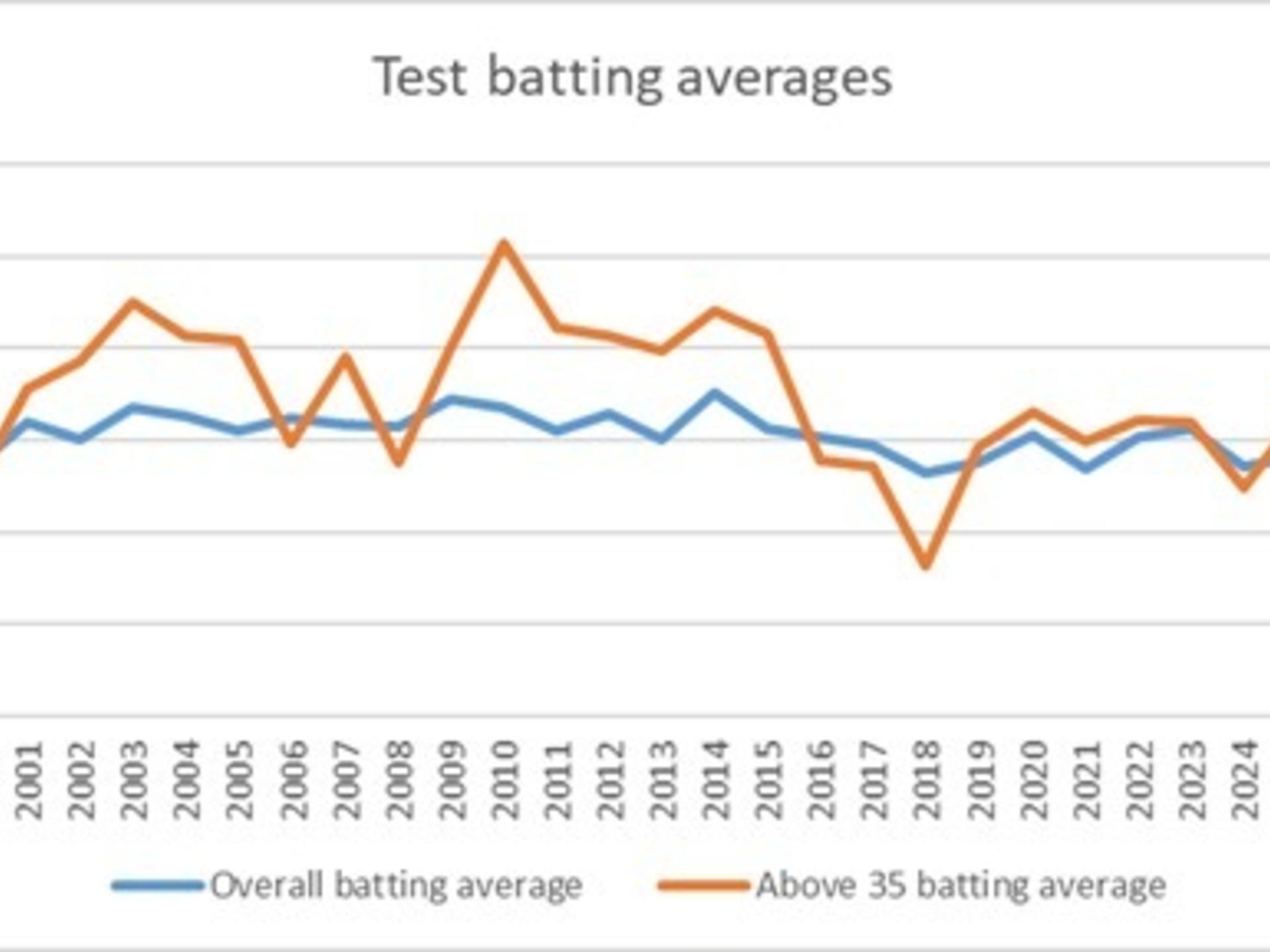
Between 2000 and 2015, batters over 35 averaged more than seven runs better than the rest of Test cricket. Since 2020, that advantage has shrunk to just over one run. Older batters are still matching the standards of the modern game, but they are no longer distancing themselves from the rest of the field in the way they once did.
Why aren’t experienced batters dominating as before?
Through much of the 2000s and early 2010s, players over 35 consistently enjoyed a sizeable advantage over the other batters, with their averages comfortably exceeding the overall Test average. Since the middle of the last decade, however, that edge has steadily diminished. The gap disappeared altogether in 2017, when older batters collectively averaged below the rest of the field, and while it has recovered since, it remains well below the levels seen in the previous era.
Between 2000 and 2015, many of the game's greatest batters continued to produce elite returns well into their late 30s. After turning 35, Younis Khan averaged 60.73 in 25 Tests with 11 centuries, while Kumar Sangakkara averaged 60.19 with eight hundreds. Shivnarine Chanderpaul (57.73), Jacques Kallis (56.92), Inzamam-ul-Haq (55.53), Steve Waugh (53.20), Brian Lara (52.44), Misbah-ul-Haq (50.54) and Michael Hussey (50.50) all averaged above 50 after turning 35. Even Sachin Tendulkar (49.86) and VVS Laxman (48.57) finished only a fraction below that mark, illustrating how the previous generation's finest batters remained among the world's best deep into their careers.
Since 2020, Mushfiqur Rahim has led the list among players who have featured in at least 20 Tests after turning 35, averaging 49.31, followed by Usman Khawaja on 45.16. No batter has averaged above 50, while Ravindra Jadeja is the only other player to average over 40 (43.03). Angelo Mathews (38.86), David Warner (32.77) and Rohit Sharma (30.63) have all fallen well short of the standards set by the previous generation.
Test batting has become considerably harder over the past decade. The advent of the World Test Championship has encouraged more result-oriented cricket, with teams increasingly preparing pitches that offer greater assistance to bowlers. Modern cricketers also contend with heavier workloads than many of their predecessors, balancing demanding international schedules with franchise cricket and extensive travel. While none of those factors alone explains the shift, together they help explain why batting after 35 no longer brings the same advantage it once did.
…and why are the bowlers dominating more?
However, if the batters suggest that age eventually catches up with experience, the journey of the bowlers tells a very different story.
Period | 35+ Bowl Avg | Overall Bowl Avg | Difference |
2000-2015 | 32.22 | 33.99 | -1.77 |
2020-2026 | 26.72 | 29.64 | -2.92 |
Negative bowling difference indicates the 35-plus group had a better (lower) bowling average.
Between 2000 and 2015, bowlers aged 35 and above averaged 32.22, slightly better than the overall Test bowling average of 33.99. Since 2020, that advantage has grown, with the 35-plus group averaging 26.72 compared to the overall figure of 29.64.
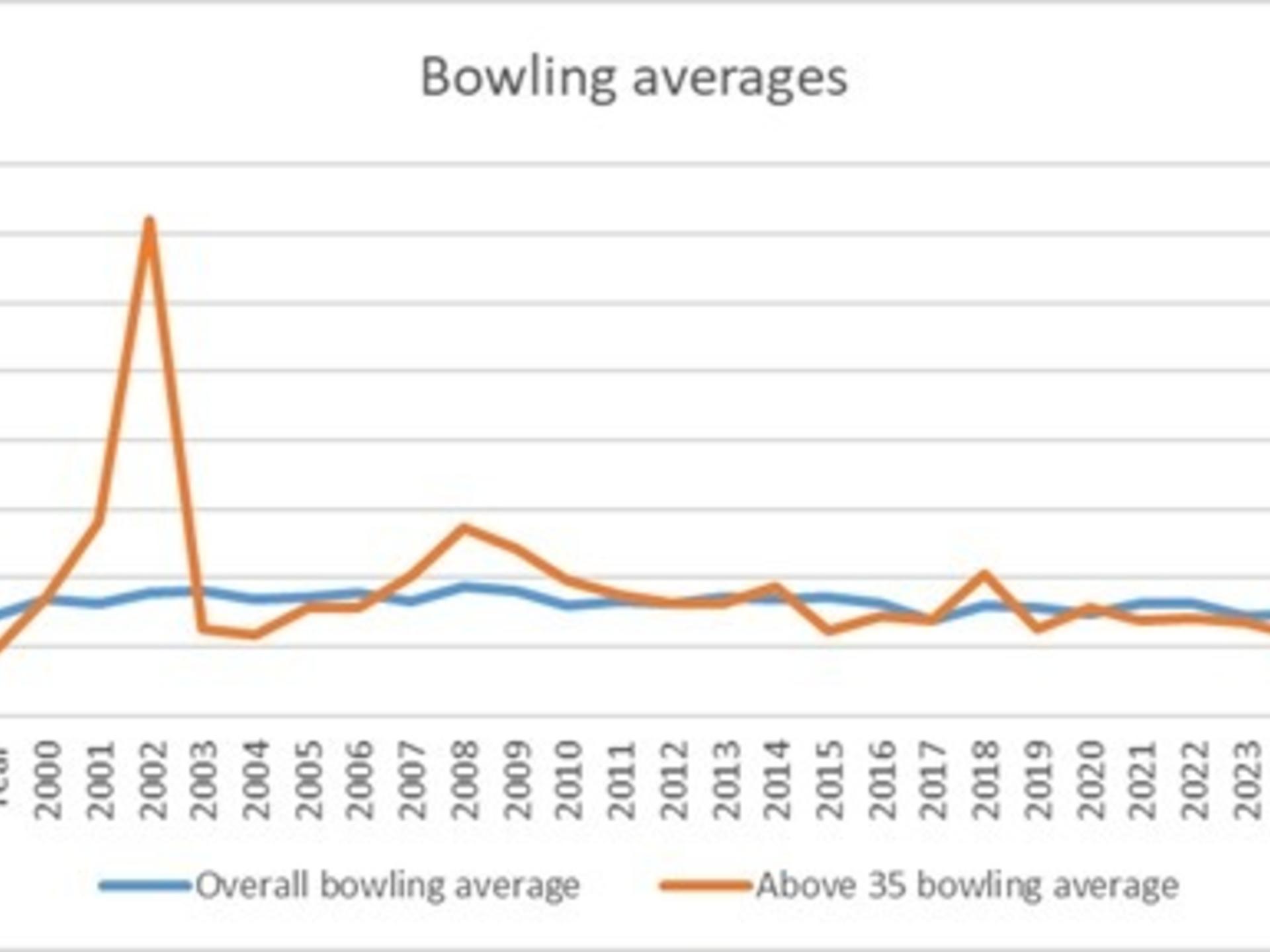
The year-by-year numbers tell much the same story. Apart from 2003, an obvious outlier, experienced bowlers have consistently matched or outperformed the wider bowling group. Unlike batting, where the gap between older players and the rest of the field has narrowed considerably, bowling has shown remarkable continuity across the last quarter of a century.
Batting is often at the mercy of physical attributes that naturally decline with age. A fractionally slower reaction, a slight delay in picking length or movement, or a marginal drop in footwork can make the difference between a hundred and an edge to slip. Bowling, by contrast, allows experience to become part of the skill itself. Years spent understanding conditions, reading batters, setting them up over spells and adapting to changing situations often compensate for any physical decline.
Fast bowlers now have their workloads managed more carefully than ever before, allowing them to remain effective for longer, while spinners continue to rely on attributes that tend to improve with experience rather than diminish. Accuracy, control, variation and game awareness are qualities built over thousands of overs, making bowling one of the few disciplines where age can remain an advantage rather than a limitation.
The recent figures are inevitably shaped by four extraordinary careers. R Ashwin, Ravindra Jadeja, James Anderson and Nathan Lyon account for much of the post-2020 sample, and all four remained among the world's leading Test bowlers after turning 35, reinforcing a pattern that has existed for decades. While batting after 35 appears to have become progressively harder, bowling has continued to reward experience in much the same way it always has.
So, does age still matter in Test cricket? The data suggests it does, though not in the way we often assume. Older batters no longer enjoy the same edge over the rest of the field that they once did, even after accounting for changing batting conditions. Bowlers, meanwhile, continue to demonstrate that experience remains one of the game's greatest assets. Age has not become irrelevant in Test cricket. If anything, this analysis suggests it continues to shape the game's two disciplines in very different ways.
Follow Wisden for all cricket updates, including live scores, match stats, quizzes and more. Stay up to date with the latest cricket news, player updates, team standings, match highlights, video analysis and live match odds.