Several T20 tournaments have popped up across the globe in the last few years, but which one is the most competitive?
What exactly defines how competitive a T20 tournament is remains an inherently subjective question. For some, competitiveness is reflected in how evenly matched the teams are, with frequent upsets and a tightly contested points table. For others, it lies in the quality of cricket on display, shaped by the depth of talent, tactical astuteness, and the presence of elite international players. In a format as volatile as T20 cricket, where a handful of overs can decisively alter the course of a match, pinning down a single, universally accepted definition is particularly difficult.
This article seeks to approach the question from a narrower but more measurable angle. Rather than focusing on team parity or star power, it frames competitiveness as the balance between bat and ball across a tournament. By this definition, a genuinely competitive T20 league is one in which neither discipline consistently dominates, where both batters and bowlers are required to adapt, and where one-sided contests are relatively infrequent.
The analysis is restricted to ten leagues: the IPL (India), The Hundred (England), CPL (West Indies), LPL (Sri Lanka), BBL (Australia), ILT20 (UAE), SA20 (South Africa), BPL (Bangladesh), PSL (Pakistan), and MLC (USA), all of which regularly feature overseas players. To ensure the sample size meets the modern scoring trends, only matches played since the start of the 2022/23 Big Bash League season have been considered.
Which tournament offers the best balance between the bat and ball?
If we compare the batting strike rate across tournaments, it offers a useful indication of how easy or difficult it has been to score runs consistently. The 2025 edition of the Indian Premier League stands out as the most high-scoring tournament in this phase, with a strike rate of 152.39. The 2024 edition follows, with a strike rate of 150.58.
While runs flowed freely, the same period was far less accommodating for bowlers. The bowling strike rate in the 2025 IPL was 19.8, the fifth-worst among the 32 tournaments considered. These figures underline the extent of batting dominance during the season: not only were batters scoring heavily before losing their wickets, but bowlers were also taking longer than in most other leagues to make inroads. The combination places the 2025 IPL firmly among the most batter-skewed tournaments in the sample. However, the IPL was also the only league with the Impact Player rule, effectively giving teams an additional batter, which goes some way to explaining the soaring run rates.
On the other hand, the 2023 edition of the Lanka Premier League saw a strike rate of 120.28 - the lowest among all tournaments. It also had a bowling strike rate of 18.8, making it far more favourable towards the bowlers.
A competitive league should not have either department dominating heavily, but should be closer to the equilibrium. When both batting strike rate and bowling strike rate are high, it indicates a batting-dominant format where batters score quickly and rarely get out. If the batting strike rate is high but the bowling one is low, it suggests a balance: batters score fast but also get out more often. Conversely, when both batting and bowling strike rates are low, the tournament leans toward bowling dominance, with batters scoring slowly and losing wickets frequently. Finally, if the batting strike rate is low and the bowling strike rate is high, there is another kind of balance, where batters score slowly but tend to stay at the crease longer.
1st innings vs the 2nd innings: How easy is it to score runs in the leagues?
Another important metric to assess the balance of a cricket competition is how scoring varies between the first and second innings. In leagues dominated by day-night matches, the effect of dew can play a significant role, often making the ball harder to grip in the second innings and influencing whether high totals are more easily chased or defended.
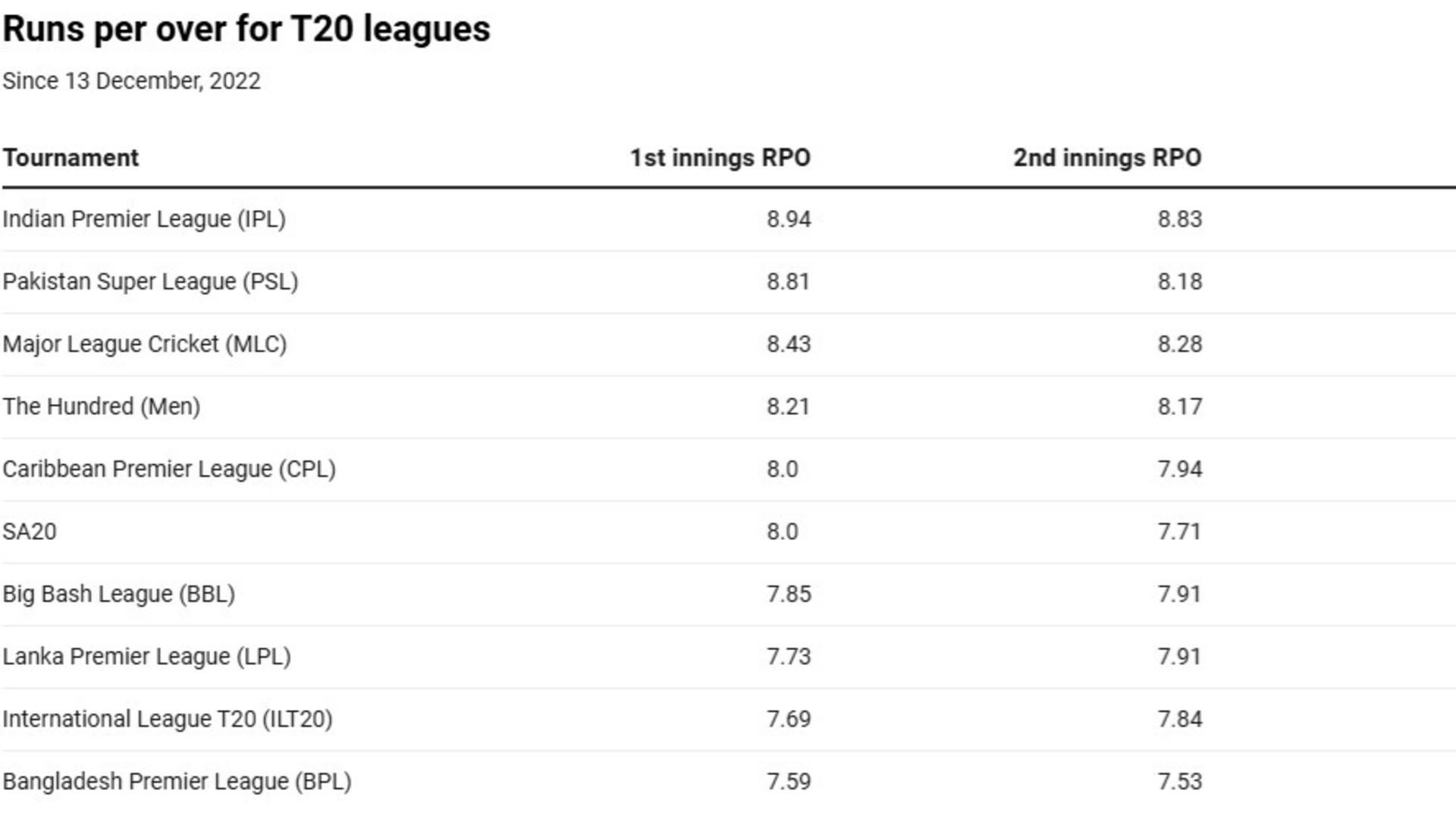
A higher run rate in the second innings suggests friendlier chasing conditions, while a narrow gap, in turn, indicates a more level contest, although how close a match has been depends on the margin of victory.
Since the start of the 2022/23 BBL, a total of 1,181 T20 matches have been played across the ten leagues. Of them, eight have been tied, while 63 have been won by a margin of five runs or fewer, giving a sense of how competitive a game actually was.
Fifteen matches in the IPL in the last three seasons have been won by a margin of five runs or fewer, with 10 close games in the Hundred. However, considering that there have been 216 IPL matches - the most among all tournaments in the last three seasons, the percentage of close games has gone down. Overall, The Hundred has produced the most exciting cricket, with 10.2% of games being won by five runs or fewer, followed by the PSL (8.08%), and then the IPL (6.94%).
If a league regularly sees 180-plus totals being chased successfully, it suggests that even above-par first-innings scores do not guarantee safety. That points to batting depth, favourable conditions under lights, and limited scoreboard pressure. all of which reduce the advantage of batting first and compress the gap between “good” and “winning” scores.
Conversely, if totals around 140 are frequently defended, it indicates that bowlers and conditions can still dominate. This again reflects competitiveness, but of a different kind, where there is little room to recover once momentum is lost.
A league becomes less competitive when results cluster at one end: if 180 is rarely safe or 140 often is (and vice-versa), the game state becomes predictable early. In the latest edition of each competition, 180 has been chased down 39 times: 15 times in the IPL, further reinforcing how batters were aided in the 2025 edition, while five 180-plus successful run chases were in the PSL. The other leagues where 180 has been chased successfully are the BBL (four), MLC (eight), CPL (five), along with the BPL and The Hundred (one each). However, with the Hundred being limited to 100 deliveries, they are not on a level field with other teams.
Overall, 140 has been defended just seven times since March 2025 (which accounts for one season of all leagues). Going back to our original date filter, the number is 34, with 10.2% games coming from the Hundred, followed by the Big Bash League, where 3.6% games have been won after sides have defended 140. Interestingly, no game in the PSL has been won when the target to be defended is 140 or fewer.
Ultimately, the competitiveness of a T20 league comes down to a balance between bat and ball, the closeness of contests, and the unpredictability of outcomes. Leagues where both disciplines influence results and matches are frequently decided in the final overs foster genuine tension and excitement. By this measure, tournaments like The Hundred and the CPL exemplify the ideal equilibrium, while leagues dominated by batting, such as the IPL, offer spectacle but less strategic balance. Competitiveness, therefore, is less about high scores or star power and more about creating conditions where every match feels finely poised until the end.
Follow Wisden for all cricket updates, including live scores, match stats, quizzes and more. Stay up to date with the latest cricket news, player updates, team standings, match highlights, video analysis and live match odds.