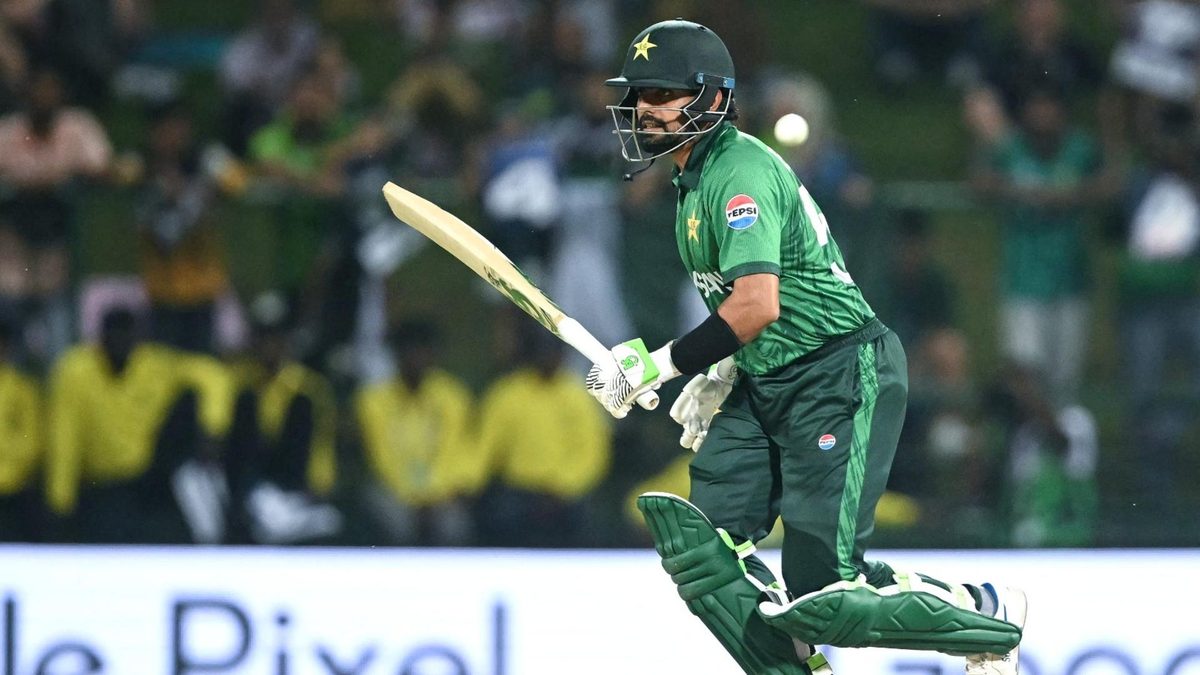
For the longest time, Babar Azam was the calm in the storm for Pakistan.
In the chaotic, high-octane act of a T20 innings, he was the anchor. You knew that no matter what was happening at the other end, he’d be staying there, accumulating runs with elegance.
His way of playing wasn't just acceptable then: it was the whole game plan. Let Babar hold one end up, and everyone else could play with freedom. But things have changed.
And now, so have the opinions and conversation around him.
'That's not a role we think we need'
For the first time in his career, a Pakistan head coach has publicly, and very bluntly, pointed out the limitations in Babar's T20 game. Mike Hesson didn't sugarcoat it. He accepted categorically that Babar's strike rate in the powerplay in T20 World Cups is under 100, and added “that’s not a role we think we need here”.
Let that sink in. The coach of the national team is saying the team doesn't need its best batter doing what he does best at the start of the innings and the numbers back him up. Babar had scored 187 runs off 217 balls in the powerplay across four T20 World Cups. A strike rate of 86. In a format where the first six overs are treated as a platform to launch the assault, these numbers highlight the limitation of Babar Azam’s style of batting.
Also read: T20 World Cup semi-final scenarios: What Pakistan need to qualify after defeat against England
Hesson's solution is to reframe Babar's role entirely. He identified Babar’s value saying that Babar is a fine player through the middle if required. “If we’re in a little bit of trouble… once he gets himself set, he can increase his strike rate at that point.”
We even saw this play out against Namibia. Pakistan were cruising, wickets in hand, and they actually sent the big hitters in before Babar. Hesson’s reasoning was brutally honest that others can do that finishing job more efficiently. He even added, “From that point, Babar’s not the best person to come in.”
This is not an attack on his ability. It is an admission about fit.
Babar's awkward fit in T20 cricket
The criticism hasn’t just come from the coach. Former captain Rashid Latif was even more direct, questioning why Babar was even brought back into the T20 side after being dropped for the very same strike-rate issues. “He is no longer a player of this format,” Latif said. His point wasn't about Babar's talent, but about the modern game itself. T20 now demands batters who can shift gears instantly and naturally.
When Babar uses up 20 balls for 20 runs, the pressure doesn't vanish. It gets passed down the order. The new batter walks in with a sense of urgency that often leads to reckless shots and quick wickets.
The discussion around Babar Azam has also opened the door for technical scrutiny, too. His recent struggles against quality leg-spin, like England’s Adil Rashid, have highlighted a potential weakness. When he's forced to go big against a top spinner in the middle overs, his usual style of precise timing and control can become uncomfortable.
Read more: Promoting the 'finisher': Why T20 teams don't do it, and when they should consider it
And that brings us to the role of a modern No.4. It's a position that demands instant impact. You’re supposed to walk in and start looking for the boundary from the start to keep the momentum going. There’s no time for ‘settling in’. Babar, by his very nature, needs time. He scores a boundary roughly every nine or ten balls, and the current game often needs one every four or five.
Even Michael Vaughan, who calls Babar a “beautiful player,” has wondered if T20 is still his best format. He talked about how T20 has become a power-hitter's game, dominated by force. His suggestion was a practical one: maybe stepping back from the shortest format could actually help prolong Babar's career in the formats where he truly excels, Tests and ODIs.
So, what’s the answer?
The core issue isn't whether Babar is a great player. He is, and there is no doubt about that. It is about whether Pakistan's T20 team has a clear role for him that actually works.
If he opens, his powerplay strike rate stalls momentum. If he bats at four, his natural style of play clashes with the immediacy demanded of that position. If he is held back as insurance, Pakistan are building for recovery rather than dominance.
Hesson insists Babar has “a certain set of skills the team require.” Yet those skills now seem situational. Anchoring in crisis or stabilizing after collapse instead of being a figure of the team's attacking identity.
Right now, it doesn’t feel like Babar is in the team because the plan demands him. It feels more like that the team is trying to find a plan that fits him. Instead of defining a clear role and picking the best player for it, Pakistan seem to have picked Babar first and then worked backwards to justify where he should bat.
One thing is becoming increasingly hard to ignore: T20 cricket has accelerated, and Babar Azam’s game hasn't kept pace. He remains indispensable in Tests. He remains elite in ODIs. But in T20 internationals, he now occupies a space defined by “if required,” “if in trouble,” or “once set.” For a player once considered Pakistan’s white-ball certainty, that is a profound shift.
In T20 cricket, beauty is admired. Impact is demanded.
Follow Wisden for all cricket updates, including live scores, match stats, quizzes and more. Stay up to date with the latest cricket news, player updates, team standings, match highlights, video analysis and live match odds.