Zimbabwe toured England in 2025 for one Test match and lost the game. Kit Harris’s tour report as well as the match report appeared in the 2026 edition of Wisden Cricketers' Almanack.
England v Zimbabwe in 2025
Test match (1): England 1, Zimbabwe 0
For England, this was a throwback: a one-off Test against a far-off nation, apparently to help their cricketing development. The match was not part of the World Test Championship, for which the ICC considered Zimbabwe too weak – “informal segregation”, according to the chairman of their board, Tavengwa Mukuhlani. “If you look at football, which has grown phenomenally, Brazil play Honduras, England play Malta,” he said. “How do you want the smaller nations to survive? Do you even want them to survive?” Richard Thompson, his opposite number, clearly did: “We need to have really strong competitive cricket. There’s a responsibility to ensure we can share out the value the game creates, in order to keep that going.” The ECB put their money where Thompson’s mouth was, handing Zimbabwe a tour fee of £150,000. The gesture wasn’t wholly altruistic – the Sky Sports broadcast deal demands six home Tests a year – but it was without modern precedent.
For Zimbabwe, this was a comeback. They had played every Test side since they last faced England, at Chester-le-Street in 2003, and the subsequent careers of those teams vividly illustrated the contrasts between cricket’s haves and have-nots. Ten of the English had enjoyed success off the field: six as backroom staff (Marcus Trescothick, Alec Stewart, Anthony McGrath, Ashley Giles, Richard Johnson and Rob Key), and four in the media (Michael Vaughan, Mark Butcher, Nasser Hussain and Steve Harmison). The other, James Anderson – who made his debut in that series – was still playing for Lancashire, and had just been awarded a knighthood. The Zimbabweans’ fortunes had been rather different. Mark Vermeulen had burned down the national cricket academy, then was banned for comparing black Africans to apes. Dion Ebrahim was arrested for failing to return a sponsored car after losing his central contract. Douglas Hondo quit international cricket after the board ordered him to have his dreadlocks cut off. Tatenda Taibu fled the country after the attempted kidnapping of his wife. When captain Heath Streak was sacked in 2004, the other six went on strike, throwing the Test team into crisis (Streak was banned for corruption in 2021, and died two years later).
But after 14 Tests in seven years, the Zimbabweans were experiencing a renaissance, with ten in 2025 alone; only Australia had more. And despite the inevitable mismatch – scheduled for four days, but over in three – the crowd at Nottingham cheered them at every opportunity. Dozens of England fans, especially children, left sporting Zimbabwe cricket jerseys. Pre-match moaners of two types – the “this is a waste of time” brigade, and the “four-day Tests are the thin end of the wedge” purists – were left with little to say. The game may have been short on good cricket, but it was good for cricket nonetheless.
Several England players added twists to familiar tales. Either Zak Crawley or Ollie Pope, it was said, would have to be dropped when Jacob Bethell returned from the IPL for the India series – but they both made assertive hundreds on the first day. Jordan Cox, for the second time in six months, was called up to the squad, only to suffer injury. This time it was a side strain; Somerset wicketkeeper James Rew took his place. Shoaib Bashir responded to criticism of his control with nine wickets, but Sam Cook – with 321 first-class victims at 19.85, as ready for Test cricket as any seamer could be – lacked a cutting edge. With Chris Woakes (ankle) and Brydon Carse (toe) recovering from injury, Josh Tongue and Gus Atkinson were the frontline quicks, but both were comfortably outbowled by Ben Stokes, back at full tilt after hamstring surgery.
Zimbabwe’s batters – coached by former England No.3 Gary Ballance – were briefly as exhilarating as England’s seamers were disappointing. Brian Bennett broke Sean Williams’s record for the fastest Zimbabwean Test hundred, and Williams looked like reclaiming it in the second innings, before becoming the first of Bashir’s career-best six for 81. Sikandar Raza, likewise, batted as if he had a plane to catch – and indeed he had. Within hours of the finish he was bound for Lahore, where he arrived ten minutes before the toss in the Pakistan Super League final. Unlike his Test team-mates, he saw out the weekend with a win.
Zimbabwe’s touring party to England, 2025
*CR Ervine, BJ Bennett, LT Chivanga, BJ Curran, TW Gwandu, C Madande, WN Madhevere, WP Masakadza, B Muzarabani, R Ngarava, NT Nyamhuri, VM Nyauchi, Sikandar Raza, TE Tsiga, NR Welch, SC Williams. Coach: J Sammons.
Gwandu injured his groin in training, and was replaced by Chivanga. AT Falao and VR Masekesa played in the game against the South Africans.
At Leicester, May 15–18 (not first-class). Professional County Club Select XI won by 138 runs. Professional County Club Select XI 330 (71.2 overs) (JM de Caires 79, JA Richards 32, SHB Morgan 66*, JA Chohan 56, Extras 35; R Ngarava 3-42) and 464-7 dec (97 overs) (JM de Caires 84, DR Mousley 154, THS Rew 103*; NT Nyamhuri 3-74); Zimbabweans 403 (97.4 overs) (BJ Bennett 65, SC Williams 76, WN Madhevere 93, TE Tsiga 66, WP Masakadza 34*, Extras 33; MJ Killeen 3-52) and 253 (66.5 overs) (NR Welch 87, TE Tsiga 66*; EV Jack 3-40).
Josh de Caires captained the county side, which featured 13 players, three without a contract (Ben Dawkins, Ben Mayes and Tom Rew), and three without first-class experience (Jafer Chohan, Eddie Jack and Seb Morgan). Like de Caires, Zimbabwe wicketkeeper Tafadzwa Tsiga batted well in both innings, but ran out of partners in the final session.
Only Test at Nottingham, May 22-24, 2025
England won by an innings and 45 runs. Toss: Zimbabwe. Test debut: SJ Cook.
As first days go, a cold Thursday in spring, against an unfashionable team, was a hard sell. But while the weather was chilly, the atmosphere was warm: those who did come were the diehards, parka-clad and Tupperware-toting, happy to see a Test at Nottingham, whoever was touring. A smattering of Zimbabweans were there too, noisily hallooing their team in Shona, and a Beatles tribute act gave a rooftop performance before the toss. As Ervine – who at 39 had succeeded James Anderson as Test cricket’s oldest current player – announced Zimbabwe would bowl, the band struck up “Help!”
Sticking England in might have been right, given the conditions, but Ervine’s four frontline seamers bowled with neither discipline nor luck. Muzarabani, the best, found movement, but from too short a length. The others were so out of their depth, they could have swapped sweaters for lifejackets.
England raced along at nearly six an over. It wasn’t Bazball – they just took what was on offer. Duckett reached his half-century first, with a flash over the cordon. In the 21st over, the hundred partnership was raised; in the 22nd, Crawley ended a run of ten innings without a fifty. The ball flew everywhere, before and after it hit the bat. At lunch, it was 130 without loss, and the bowlers’ pitch map looked like an explosion in a paint factory.
Sikandar Raza’s off-spin was called upon immediately after the interval. Having hotfooted it from the group stage of the Pakistan Super League, he seemed unable to switch out of T20 mode, hiding the ball behind his back, bowling several variations an over, and making it impossible to set a field. Duckett, on his home ground, swept relentlessly. Attempting to intercept, Ngarava fell, clutching his back, and left the field in a groundsman’s buggy. He returned in the evening, but soon hobbled off again.
At 164, Crawley and Duckett had the highest opening stand in a Trent Bridge Test since Geoff Marsh and Mark Taylor put on 329 for Australia in 1989. Duckett reached a century from exactly 100 deliveries. The Zimbabweans were allowed a replacement ball after 34 overs – the original had been bashed out of shape – but by then the slips had gone, and so had hopes of an even contest.
The partnership was 231 when Duckett, having greeted Madhevere’s club-standard off-breaks with a four and a six, slapped a drag-down to cover. The relief was fleeting: Pope survived an ambitious lbw appeal first ball, cut his second to the boundary, and normal service was resumed. Crawley reached his hundred from 145 – more than Duckett had needed for his 140, but calmer and less risky. For the first time since Graham Gooch and Mike Atherton, against India at Manchester in 1990, both England openers had scored a hundred in a home Test innings. At 119, Crawley edged a pull off Chivanga into his hip, and began limping; Sikandar soon won an lbw appeal, ending a stand of 137.
On the eve of the game, Stokes seemed to suggest Jacob Bethell would return to the Test team on his return from the IPL, though he later insisted he was talking about the squad, not the XI. If that put pressure on Pope, he showed no sign. He struck a boundary almost every six balls – including an outrageous, full-stretch upper-cut off a Muzarabani bouncer – in a chanceless 171 that booked him a berth for the India series. He now had eight Test centuries, against eight different teams. Root, meanwhile, became the fifth to 13,000 runs, before hooking Muzarabani to long leg. At stumps, the score was 498 from 88 overs. Those who felt a four-day game was disrespectful to Zimbabwe had surely revised their opinion of what constituted humiliation. At times, it was hard to watch.
England batted on for 45 minutes in the morning. Just after bringing up 500, Pope snicked a Chivanga outswinger, and inexplicably reviewed. Chivanga should have had two more, but Wellington Masakadza – on for Ngarava – reprieved Brook at deep third, and Tsiga misjudged a catch off Smith. Muzarabani was repeatedly skewered by Brook’s hook, which reaped three carefree sixes, though he did bounce out Stokes. After bringing up a 48-ball fifty, Brook played on, and the declaration came.
Not since the last Test between these teams, 22 years earlier, had England fielded such an inexperienced seam attack. Between them, Atkinson, Tongue and Cook had 13 caps – and it was Cook who bowled the opening over. He was the first England debutant to do so since Martin McCague, at this ground, in the 1993 Ashes, but his selection was less of a surprise: he had been pulling up trees for Essex, and had waited an eon for his chance. His lack of speed was obvious – the first over averaged 81mph and went for 12 – but his lack of penetration was a disappointment. By the third day, he was in the mid-70s and, though his accuracy improved, he posed little threat, especially when he tried to join in with a bouncer barrage.
Cook claimed his only wicket of the match when Curran snicked to second slip in the fifth over. Atkinson was faster, but couldn’t find the pace with which he had burst on to the international stage a year earlier. Tongue (quick but erratic) and Bashir (just erratic) also fell short of expectations, as did England’s fielding. Bashir eventually produced a ripper to find Ervine’s edge and, at 21 years 222 days, replaced Steven Finn as the youngest England player to take 50 Test wickets; he also sneaked one through Williams. But the afternoon belonged to Bennett. Driving and cutting with panache, and with his mind firmly on attack, he brought up his fifty from 56 balls, then – with three successive fours off Atkinson – a century from 97, beating the Zimbabwe record of 106, by Williams against New Zealand at Bulawayo in 2016.
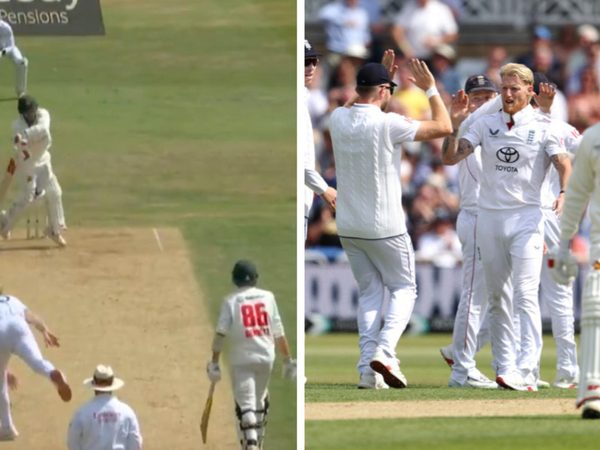
From 187-3, the visitors might have won the day, but for an injury to Bashir: a missed return catch from Sikandar had cut his finger, persuading Stokes to take over from the Radcliffe Road End. He had Bennett dropped in the slips by Root from his first legal delivery, turned Sikandar inside out, then beat Madhevere all ends up, and England took control. Bennett had reached 139 when, facing Tongue, he gave Pope a difficult catch at short square – off a no-ball – then, five minutes later, an easy one. Bashir, patched up and back on, bowled Tsiga through the gate with a bucket-list off-break, and Chivanga (whose all-round contributions to this game suggested he was three places too high at No.9) was lbw to Atkinson’s yorker. When Muzarabani missed a straight one, and with Ngarava unable to bat, Zimbabwe followed on, 300 behind. Two fell in the 45 minutes before the close: Bennett leg-before to Atkinson, Ervine at bat–pad off Tongue.
Not everything went England’s way next morning. Atkinson tweaked his hamstring in the first session, and the scratchy Curran was reprieved three times: he gave Stokes a hard return catch on ten, an even harder one at mid-wicket on 29, then overturned an lbw call off Bashir on 30. Williams, by that point, had raced to 87 off 78, seemingly determined to reclaim his fastest-century record – but he missed a sweep in Bashir’s next over. Curran chipped to cover and, after passing 200, Zimbabwe slumped once more. As in their first innings, Stokes was the greatest threat. He removed Madhevere thanks to a superb, one-handed, overhead slip catch from Brook; goalkeepers, salmon and Paul Collingwood were all mentioned. Bashir bowled many a four ball (six to Sikandar alone), but also an occasional fizzer, and he finished with his best first-class figures, the first six-wicket haul by an English spinner at home since Moeen Ali, against South Africa at Lord’s in 2017.
For the Zimbabweans, the Test was a comprehensive defeat, and yet – by taking place at all – it was a heartening return to English soil. As Sikandar packed his bags for a dash to the PSL final, the players walked the boundary, thanking not just their supporters but the thousands of English fans who had turned out. Their reception was of the sort usually reserved for a team who had succeeded against the odds. And to their own fans, who gathered beneath the press box and sang boisterously for an hour after the finish, they had.
Player of the Match: S Bashir. Attendance: 37,813.
Follow Wisden for all cricket updates, including live scores, match stats, quizzes and more. Stay up to date with the latest cricket news, player updates, team standings, match highlights, video analysis and live match odds.