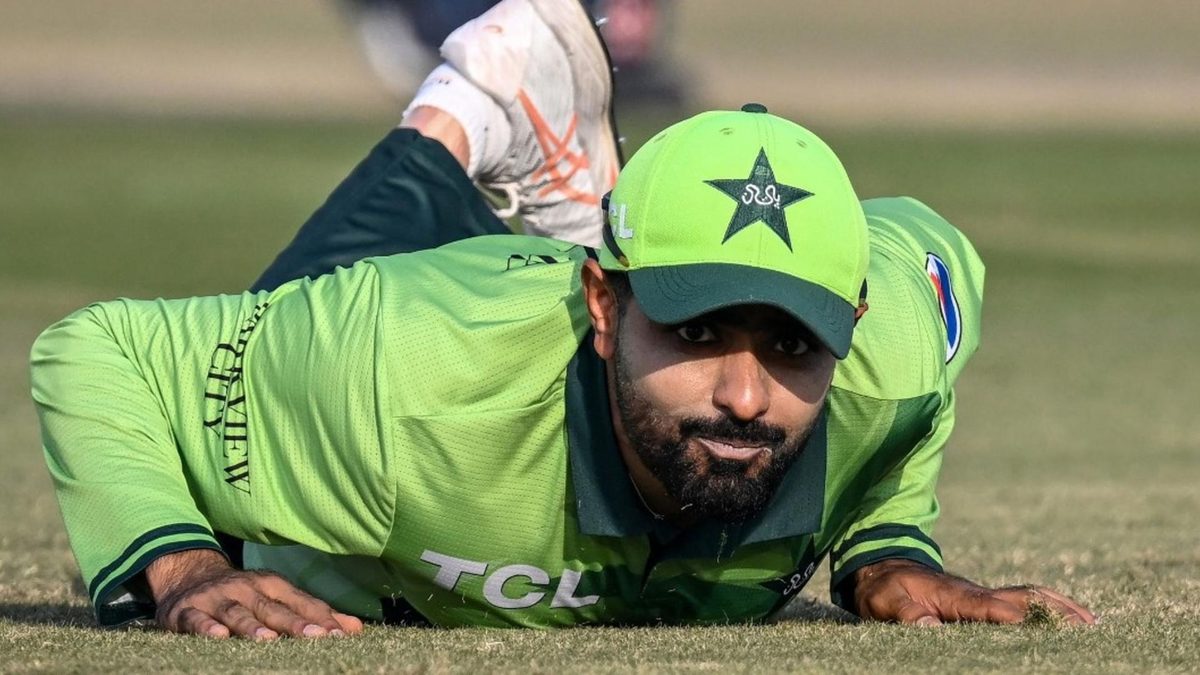
Babar Azam has returned to Pakistan’s T20I side, but should he be picked for the T20 World Cup squad next year? Sarah Waris argues that the answer is no.
If there is one word that best describes Babar Azam’s international career so far, it might be 'furore'. Tipped early on to become an all-time great, the 31-year-old has spent much of his career under intense scrutiny. After wowing the world with his cover drive to earn Fab Four comparisons, the conversation shifted. His captaincy tenure, the constant back-and-forth around it, questions over his batting approach in the shorter formats, and a prolonged lean patch only amplified the noise. Earlier this year, after an early exit from the Champions Trophy, the PCB finally decided to take the bold step and drop Babar from the T20I side, with the team hopeful of adopting a more aggressive approach going forward.
The decision was not without reason. From January 2022 to December 2024, Babar struck at 129.37 in T20Is. Only six Full Member batters with more than 1,000 runs in this period had a strike rate lower than him: Ibrahim Zadran, Pathun Nissanka, Mohammad Rizwan, Andy Balbirnie, Lorcan Tucker and Litton Das. As the format continued to evolve towards greater power-hitting, he struggled to keep pace. Along with Rizwan, Babar found himself sidelined during the New Zealand tour after the Champions Trophy this year, and for the first time, it felt as though the team had begun to move on.
Pakistan’s head coach Mike Hesson later clarified that Babar had been asked to “improve his strike rate”, suggesting the Big Bash League in Australia as an opportunity to work on his T20 batting and push for a comeback.
But by October, he was back in the T20I setup, despite not having played a single T20 since Hesson’s statement. The return, however, was hardly unexpected. In a system where retirement reversals, puzzling call-ups and frequent captaincy changes are common, persisting without their biggest batting star for much longer was never likely. But have Pakistan made the right decision?
Babar Azam's T20I comeback - a mixed bag
Since his T20I comeback, Babar has scored 206 runs in eight T20Is, along with three ducks. More importantly, his strike rate is 114.44. He struck a 47-ball 68 in the third T20I against South Africa, in a run chase of 140, and scored 74 off 52 balls in the next game, helping Pakistan reach a score of 195. Sahibzada Farhan also made a 41-ball 63, at a strike rate faster than Babar, while top-order batter Fakhar Zaman, who has been forced to bat down the order with Babar now at No.3, made a 10-ball 27.
It’s a situation their neighbours, India, were also dealing with until very recently: The shoehorning of Shubman Gill at the top meant that Sanju Samson, who excelled as an opener, was made to bat out of position in the middle. He did not find the going easy.
Just like for India, this change was not really needed. Pakistan’s T20I team was slowly beginning to take shape as their most formidable T20I side ever. That progress was inseparable from Babar and Rizwan’s absence. Between January 2023 and December 2024, in the matches Babar and Rizwan played, they faced 42.32 per cent of all balls faced by Pakistan. The duo struck at 128.17 while the rest of the team scored at 133.63. However, it also reflected a lack of consistent run-scoring in the order. In this period, batters between 5-7 from Pakistan averaged just 16.62, which meant the duo had to take on the responsibility more often than not.
It was not as though opportunities for the other batters to shine were scarce: there were regular innings when one or both failed, and Pakistan even attempted to split the opening partnership, but the alternatives rarely made a sustained impact.
There was also a clear logic to Pakistan’s approach. With a strong bowling attack, they were comfortable targeting par scores and backing themselves to defend them, a method that carried them to a T20 World Cup semi-final and final. The idea behind moving on without either of them, then, was not that the batting would automatically improve, but that it would force someone else to take responsibility. It was a theory that needed testing. In the early phase without them, the signs were encouraging. Since the New Zealand tour and until the start of the Asia Cup, Pakistan’s openers scored at a run rate of 8.51, up from 7.53 between 2023 and 2024, and faced 49.4 overs across 17 matches, pushing the middle order into greater involvement.
The result was a clear rise in tempo: Pakistan’s middle-overs strike rate climbed from 117.39 in 2023-24 to 140.39 till the start of the Asia Cup. In this period, Pakistan crossed 200 four times and made over 180 three more times. The numbers fell slightly during the Asia Cup, when Pakistan made the final and gave India a real scare, but with the matches played on low and slow surfaces, the stats did not reveal the true picture of Pakistan’s overall improvement.
Without Babar in the T20I team, Pakistan won 15 of their 26 T20Is, with a win/loss percentage of 1.363, up from the 0.562 in 2024, so something was working.
Should Babar Azam have been brought back?
Let’s look at the cricketing reasons why he could have been brought back: to add experience in the top order, and to have a batter capable of holding one end up in the event of a collapse. Pakistan are also desperate to turn around their fortunes in global tournaments, having failed to progress beyond the first round in the last three ICC men’s events.
But an anchor already exists in the side. Skipper Salman Ali Agha strikes at 111.57 in T20Is, a figure that rose to 115.31 this year, and whether the team truly needs two batters performing a similar role is a fair question. Babar has also featured in the Big Bash League, scoring two off five balls and nine off 10, suggesting that the concerns around tempo have not entirely disappeared.
More than Babar himself, this is about long-term vision. Pakistan have repeatedly made knee-jerk decisions in the past, abandoning change the moment pressure builds, and it has rarely delivered sustained success. At the last T20 World Cup, they brought back Mohammad Amir and Imad Wasim after both had announced their retirements, and the move failed to pay off. This time, a shift had finally been identified: giving younger players a longer rope and allowing them to express themselves, but it needed time to settle. Committing to that plan for a year would not only have tested whether the improvement was genuine but also allowed younger batters to learn within a defined structure.
It can be argued that Pakistan have not made wholesale changes and have only brought back one player, but that raises another question: why reintroduce a batter whose template the team was trying to move away from in the first place? Why risk slipping back into the same cycle they have been trying to escape all these years?
Babar is still likely to feature in Pakistan’s T20I plans for the World Cup, and it remains possible that he is the side’s best batter. However, by going back from an approach they had consciously committed to less than a year ago, Pakistan have once again revealed a familiar instinct: when faced with a choice between persisting with change or reverting to the familiar, they tend to favour the latter. History suggests that such moves rarely lead to lasting progress, and it could well be what holds Pakistan cricket back.
Follow Wisden for all cricket updates, including live scores, match stats, quizzes and more. Stay up to date with the latest cricket news, player updates, team standings, match highlights, video analysis and live match odds.