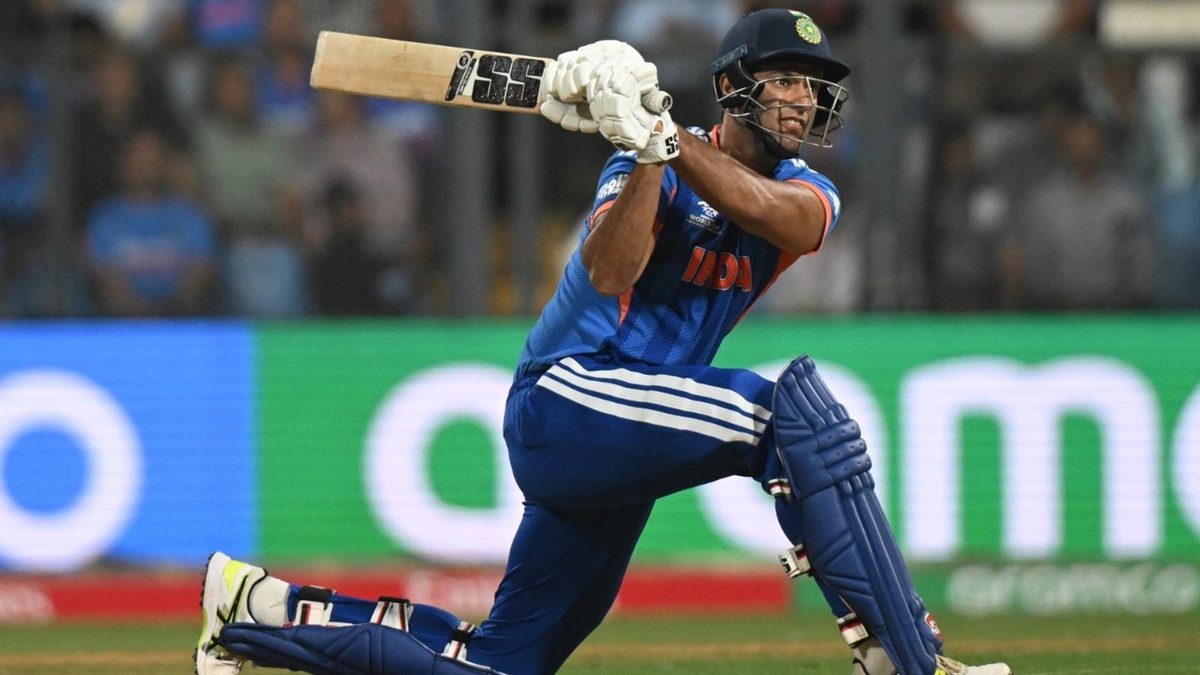
Shivam Dube may not have commanded attention through this T20 World Cup, but his quiet contributions have been vital to India's run.
If you could guess the India batter with the most sixes in the ongoing T20 World Cup, the answer would probably be Ishan Kishan. Sanju Samson, given the tournament he has had, would certainly be mentioned as well, and rightly so; he leads the chart with 16 maximums. Others might turn to the familiar power-hitting names in the side, perhaps Hardik Pandya or even the captain, Suryakumar Yadav.
Very rarely would Shivam Dube be the instinctive guess. Not the first answer, and often not even the second.
That has quietly become the theme of his international career.
Dube’s contributions tend to sit slightly outside the centre of attention. They rarely arrive wrapped in the spectacle that defines tournament narratives, yet they keep appearing when the scorecards are examined closely. In this World Cup too, he is one of four Indian batters to have crossed the 200-run mark, alongside Samson, Kishan and Suryakumar. He averages close to 35 and strikes at around 160, hitting 15 sixes, figures that would comfortably belong to a top-order batter with a clearly defined role.
Dube, of course, has had neither.
India have shuffled their batting order throughout the tournament, a tactical move that has largely worked but has often left him floating between positions. He has batted three times at No.6, twice at No.5, and once each at No.4 and No.7. For most players, that sort of movement can blur clarity. For Dube, it has simply meant responding spectacularly to moments.
Shivam Dube: India's quiet cog in the middle-order
The campaign itself began poorly, with a duck. But the first sign of his quiet influence came against Namibia. India needed someone to shift the tempo after Tilak Varma and Suryakumar managed a combined 37 from 34 deliveries. Walking in at No.6, Dube’s 23 from 16 was steady rather than spectacular, but it nudged the innings forward just enough for Hardik to arrive and produce the headline act, a 52 from 28 deliveries.
A similar pattern unfolded against Pakistan. Kishan’s 77 from 40 deliveries provided India with a strong platform, yet the innings stalled through the middle overs. When Hardik’s wicket left India at 126-4, the innings needed direction.
Dube’s response was brief but effective. His 27 from 17 deliveries carried India to 175-7. By the end of the game, the spinners dominated the conversation. Dube’s role quietly slipped into the margins once again.
His most emphatic innings arrived against the Netherlands. On a surface where no other Indian batter crossed 35, Dube produced 66 from 31 balls, an innings that stood apart and almost single-handedly carried India to a total that eventually secured a 17-run win. Yet even that performance arrived with a quiet footnote. It was, after all, a match India were expected to win.
The defeat to South Africa presented a different challenge altogether. Chasing 188, India slipped to 43-4 as Lungi Ngidi’s slower balls gripped the pitch and disrupted the chase. He began cautiously, before shifting approach once the equation climbed beyond reach in order to reduce the NRR damage. He eventually finished with 42 from 37 balls, but the focus inevitably returned to the collapse.
Even in the decisive moments of the tournament, his influence has often arrived in small but timely bursts.
Against the West Indies, in what effectively became a quarter-final, India needed 17 from the last 10 balls while chasing 196 when Dube walked out to bat. A couple of dot balls there would have tightened the pressure on Samson considerably. Instead, he began with a boundary off a yorker through midwicket and followed it with another threaded between backward point. The pressure eased almost immediately. Samson’s unbeaten 97 eventually dominated the narrative, but those strokes ensured the chase never truly stiffened. Both head coach Gautam Gambhir and pace spearhead Jasprit Bumrah acknowledged the importance of those two strokes, post-match.
In the semi-final against England, promoted to No.4, Dube offered another reminder of why India continue to trust him across different roles. His 43 from 25 balls came in an innings where several batters contributed, but his assault on spin stood out. He struck three sixes against Adil Rashid, England’s most threatening bowler, leaving them searching for answers.
Moments like these are not new in Dube’s career
In the 2024 T20 World Cup final against South Africa, India were 106 for four in the 14th over. Virat Kohli’s 76 from 59 anchored the innings, while Axar Patel, promoted to No.4, drew much of the attention with 47 from 31. The late acceleration, however, came through Dube, whose 27 off 16 deliveries pushed India to 176, a total they defended by seven runs.
Last year’s Asia Cup final against Pakistan followed a similar script. Chasing 147, India slipped to 20 for three and later 77 for four when Dube arrived. Tilak’s 69 from 53 shaped the chase, but Dube’s two sixes off Abrar Ahmed and Haris Rauf eased the pressure and allowed Tilak to guide the innings home.
There has been a role for him with the ball as well. Dube has picked up five wickets in this World Cup, and was handed the final over against England in the semi-final with 30 runs to defend. He conceded 23, but mostly after ensuring India had already closed the game out without any panic.
For a player whose first T20I stint after debuting in 2019 produced only 216 runs and five wickets, the progress has been steady. Since his return in August 2023, he has scored 860 runs at an average of 33.07 and a strike rate of 154.12. Among Indian batters with more runs in that period, only Tilak and Hardik average more, while only Abhishek Sharma and Samson score quicker. Except Hardik, they all bat in the top order. Dube, meanwhile, has also struck 55 sixes, the sixth-most by an Indian in that stretch.
The numbers have quietly piled up.
And that, perhaps, is the most telling feature about him. The louder the conversation becomes around India’s stars, the easier it is to miss the tall left-hander somewhere in the middle of the innings. For a 6'4" batter who hits the ball as far as he does, it is an unusual reputation to carry.
Then again, if nobody is asking where Shivam Dube is, it usually means he has already done his job.
Follow Wisden for all cricket updates, including live scores, match stats, quizzes and more. Stay up to date with the latest cricket news, player updates, team standings, match highlights, video analysis and live match odds.