Smriti Mandhana has evolved from a promising young batter into one of the biggest names in women's cricket, with her numbers making a case for her as a standout all-format batter of this era.
It was a sweltering afternoon at the Kotla a year ago as Australia piled up 412 in the ODI series decider. With the series level at 1-1, Beth Mooney's 75-ball 138 all but sealed the series for the visitors.
Some journalists had already wandered towards the snacks corner, hoping to gorge on the delicacies as they anticipated an early end. One by one, though, when India’s innings began, they scampered back to their seats as Mandhana began to fly. She raced to 50 off 23, tearing into the Australian attack as India reached 121-2 in 12 overs. Less than five overs later, she had reached her hundred, smashing her own record for the fastest ODI hundred by an Indian woman by 20 balls, and the fastest by any Indian, breaking Virat Kohli’s 12-year record.
She finished with 125 off 63, and India were still in the chase when she departed. They eventually fell 43 runs short, but Mandhana’s innings remained the lasting image of the day. It was not just another hundred, or another record. It was a glimpse of the distance she had travelled as the talented young batter from Sangli. Here was Mandhana in full flight: attacking Australia, changing the tenor of a chase almost single-handedly and making 413 feel, however briefly, within India’s reach.
It was just one glimpse of a steady growth that has taken place across formats. The timing and elegance that defined her when she first made waves are still very much a part of her game, but they now sit alongside greater skills, more intent and an ability to adapt her game according to different conditions.
From her ODI debut in 2013 to 2017, Mandhana averaged 30.09 at a strike rate of 76.66, with one hundred. Between 2018 and 2024, those numbers rose to 53.10 at 88.43, with seven hundreds. Since the start of 2025, she has averaged 58.04 at an average of 107.64, with five hundreds, highlighting her steady improvement.
What is interesting is how the scoring has changed. The strike rate has climbed with her average rather than at its expense, and big scores have become far more frequent. Her knock in Delhi was the clearest example of a player adding new dimensions to her batting over the years.
In T20Is, where the game itself has changed rapidly during Mandhana's career, the transformation has been equally impressive. In the first four years of her career, she averaged 17.66 at a strike rate of 96.58, hitting just three sixes across 27 innings. During 2018-24, she had become a far more reliable T20 batter, averaging 32.08 at 127.75. Since last year, her strike rate has jumped to 140.21, with her average runs in boundaries rising from 7.9 per innings to 19.5 and then 23.9 since January 2025.
Mandhana has continued her form in Tests, despite the limited number of games for women cricketers. Since January 2023, the left-hander has averaged 57.87, with the highlight being her 149 against South Africa in June 2024. With three more fifties in this period at a strike rate of 74.43, she has shown that even while excelling in the faster-paced formats, she still has the technique and the patience required for the red-ball game.
Since the start of January 2025, Mandhana has scored 2,539 runs across formats, including seven hundreds. Most of those runs have come in ODIs, where she made 1,362 runs, the most by a woman in a calendar year. Her T20I batting has also accelerated: Mandhana has scored at 14 points above her career strike rate since January 2025, with both of her hundreds coming in this period.
Her frequency of reaching three figures has also risen: she scored 11 international hundreds in her first 249 matches, compared to seven in her last 54; a hundred in 13 per cent of her matches since January 2025, against 4.4 per cent previously.
Mandhana has also excelled in big moments, playing a major part in India's ODI World Cup triumph last year, with her 434 runs at 54.25 being the second-highest tally in the tournament. Her hundred came in a crucial match against New Zealand, while she also made 80 against Australia and 88 against England. The T20 World Cup this year was less productive: she averaged 31.11 at a strike rate of 124.44, although her three fifties included a 44-ball 68 against Pakistan.
Those performances are exceptional on their own, but how good has she been when compared to her peers?
Where does Mandhana rank in the best all-format batter conversation?
To see where Mandhana stands among the leading batters of her generation, the comparison can first be narrowed using the two formats with the largest sample sizes. Since January 2025, 18 Full-Member batters have scored at least 500 runs in women's ODIs while averaging 45 or more. Mandhana has scored 1,451 runs at 58.04, with Laura Wolvaardt next on 1,392 at 55.68. Raising the average to 50 leaves ten batters, and only four of them have also struck at more than 100: Alyssa Healy (115.11), Ash Gardner (113.41), Mandhana (107.64) and Phoebe Litchfield (106.17). It is a particularly small group of players who have been able to maintain a level of consistency with higher aggression.
In T20Is, there are eight batters with at least 300 runs and a strike rate of 140 or more since the start of last year. Mandhana has made two T20I hundreds in this period, one of only three batters to do so, alongside Amelia Kerr and Wolvaardt, who do not make the cut with strike rates below 140.
The Test comparison is harder to make over the same period, with so few matches having been played. Rather than allowing such a small sample to decide the all-format argument, the Test window should be extended back to 2023 to give the format enough weight in the comparison.
Even then, the numbers need to be read with some caution. Just 63 cricketers have played a women's Test in the last three-and-a-half years, and the format has largely been restricted to the Big Three, with India, Australia and England each playing five Tests in that period. Among batters with more than 200 runs, three average above 50: Annabel Sutherland (116.16), Mandhana (57.87) and Beth Mooney (56.28).
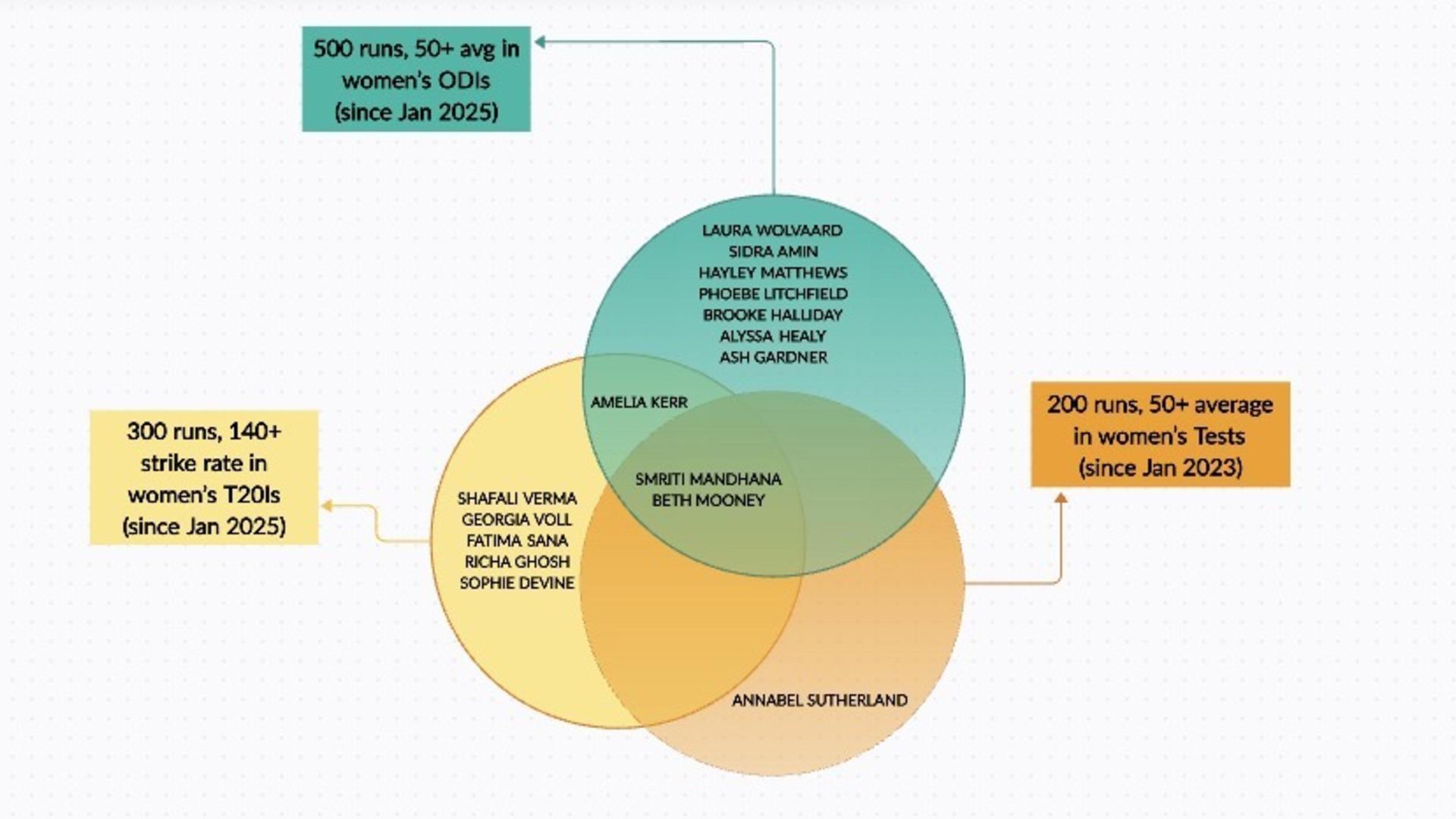
Across the benchmarks used by us, Mandhana and Mooney are the only two batters who find a name in all three formats. While it does not make them the runaway leaders in the game, it highlights something unique about the women’s game. As men's cricket has moved further towards specialisation, with players increasingly built around one format, women's cricket still has a sizeable group capable of making a mark across all three. Healy, Gardner, Ellyse Perry, Sophie Devine, Heather Knight and Nat Sciver-Brunt are also among those who have fared well across ODIs, T20Is and Tests, even if they have just about missed the statistical cut-offs used here.
But what separates the duo is their ODI consistency, a more forceful T20I game, and strong returns in the limited Tests available. How significantly they have evolved with the game also stands out.
Overall, Mandhana's importance to India goes beyond just numbers. With Jhulan Goswami and Mithali Raj gone, Indian women's cricket needed a new face to carry its story, and Mandhana has grown into that role with ease. She is now a superstar of the game, much-loved in Bengaluru and far beyond, at times even moving to tears at the amount of adulation.
Alongside all of it is the expectation that comes with being the player India can bank on, a responsibility that only grows as more pressure, including the possibility of captaincy, falls on her shoulders. And, more often than not, she has stood tall just as she did in Delhi last year, forever making the impossible look within reach.
Follow Wisden for all cricket updates, including live scores, match stats, quizzes and more. Stay up to date with the latest cricket news, player updates, team standings, match highlights, video analysis and live match odds.