Laura Wolvaardt has been good enough to make it to the GOAT shortlist among batters, already.
Convention recommends the use of Test cricket performance as the most significant parameter for evaluation of cricketers. Real cricket, they would tell you. What that definition does not tell you is that the parameter is hardly relevant in women’s cricket, where Test matches have been systematically reduced to token contests that take place once in a while.
Even when women’s Tests were a thing (well, sort of), only seven cricketers played 20 Tests. Among them, only Jan Brittin made it past 25. In women’s cricket, thus, no one has played enough Tests for the format to be the sole determining factor for greatness.
For that, one has to revert to the somewhat non-trivial exercise of combining formats. And things may be tricky if we try that. Suzie Bates, Sophie Devine, Hayley Mathews, Chamari Athapaththu have not played Test cricket, but have exceptional records in the shorter formats. Belinda Clark and Karen Rolton did play T20Is, but retired before the format could take off properly. Some legends quit even before the format came.
So who are the greatest across-format batters of all time?
Meg Lanning might have played only six Tests, but at a hundred every 6.9 games, she was an ODI run-glutton who had a reasonable T20I career. Mithali Raj’s norm-defining 23-year ODI career put her nearly 2,000 runs clear of anyone when she retired. Charlotte Edwards, whose record Raj broke, had a then world record of 13 international hundreds. Few matched Alyssa Healy’s strike rate or ability to lift her game at the biggest platform. Ellyse Perry’s versatility often obscures her incredible batting record. And Smriti Mandhana dominates bowlers with ridiculous ease across the three formats.
And then, there is Laura Wolvaardt, all of 27, set to usurp them all.
The lone Wolf rises
First things first. Wolvaardt recently completed her 17th international hundred. Lanning and Mandhana have as many – this is the world record, by the way – but they were past 29 when they got there. Wolvaardt had not even celebrated her 27th birthday.
Wolvaardt equalled the world record during the home T20I series against India. She scored 330 runs, the most by anyone in a women’s T20I series or tournament involving any number of teams. These amounted to 42 per cent of South Africa’s runs off the bat in the series. And Wolvaardt got these runs while striking at 168.
This is not a one-off. Neither has her form been restricted to one format. Last year, she amassed 571 runs (at 71.37 and 99) at the World Cup – yet again, a world record for any series or tournament (though this one is in ODIs).
For anyone to master two series in two formats in two continents over a six-month span is near-unbelievable. And yet, this phase was only a part of one of the greatest batting purple patches cricket has known: since the start of 2024, Wolvaardt has scored 12 hundreds across the three formats.
The two phases of Laura Wolvaardt
| Format | Parameter | Until 31.12.2023 | Since 1.1.2024 |
| Tests | Runs | 32 | 223 |
| Average | 16.00 | 37.16 | |
| 100s | 0 | 1 | |
| ODIs | Runs | 3606 | 2089 |
| Average | 46.23 | 63.30 | |
| Strike rate | 69.5 | 90.7 | |
| 100s | 5 | 8 | |
| Balls/Boundary | 13 | 9 | |
| T20I | Runs | 1362 | 1402 |
| Strike rate | 110.9 | 135.1 | |
| 100s | 0 | 3 | |
| Balls/6 | 82 | 45 |
Make no mistake. Wolvaardt’s ODI average of 46.23 until the end of 2023 was, while not exceptional, reasonably good. Since the start of 2024, however, her strike rate has shot up from 70 to 91. She lasts virtually the same number of balls (66.5 then, 69.8 now), but as a result of a higher scoring rate, she averages 63.30 in this phase.
Her T20I strike rates, similarly, read 111 and 135. Since the start of 2024, Shafali Verma is the only other batter to score 1,000 runs at a better strike rate (143). Verma, however, is almost always expected to score quick, not bat deep: Wolvaardt has to assume both roles for South Africa.
Each of Wolvaardt’s three T20I hundreds have come in this phase – at 61, 52, 47 balls, in that order. As an aside, her only Test hundred – a six-and-half-hour third-innings marathon at Chepauk – also came in this phase. As an across-format batter over this period, she is matched by only Mandhana.
A comparison between the two will not be out of place here. A magical 2025 has propelled Mandhana’s ODI strike rate over the same period to 103, but her average (57.84) is lower than Wolvaardt’s. Mandhana (130) has also been the slower batter in T20Is.
| Format | Parameter | Wolvaardt | Mandhana |
| Tests | Runs | 223 | 155 |
| Average | 37.16 | 51.66 | |
| 100s | 1 | 1 | |
| ODIs | Runs | 2089 | 2198 |
| Average | 63.30 | 57.84 | |
| Strike rate | 90.7 | 103.0 | |
| 100s | 8 | 9 | |
| Balls/Boundary | 9 | 7 | |
| T20I | Runs | 1402 | 1295 |
| Strike rate | 135.1 | 130.0 | |
| 100s | 3 | 1 | |
| Balls/6 | 45 | 36 |
So what has changed for Wolvaardt? Her technical brilliance and temperament were always tailor-made for ODIs (and the occasional Test match), but since the start of 2024, a newfound dimension to power-hitting has transformed Wolvaardt the batter.
She has now opened up the leg side significantly more. In T20Is, her strike rates have skyrocketed against both bowling types, from 110 to 142 against pace, and from and 113 to 125 against spin.
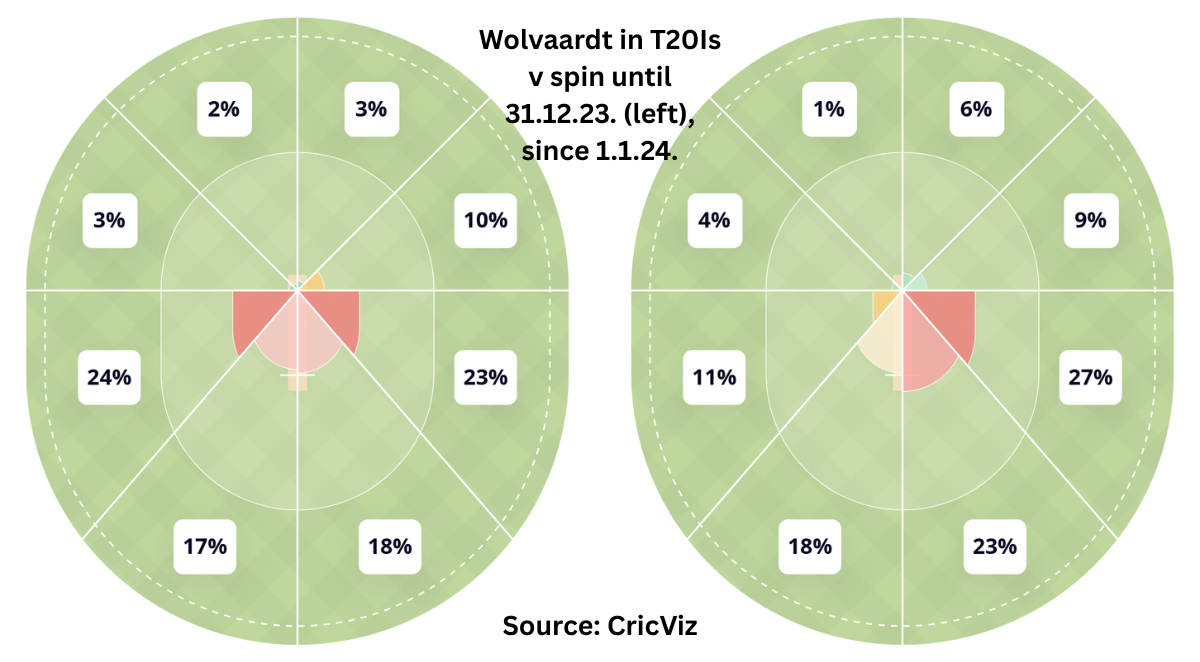
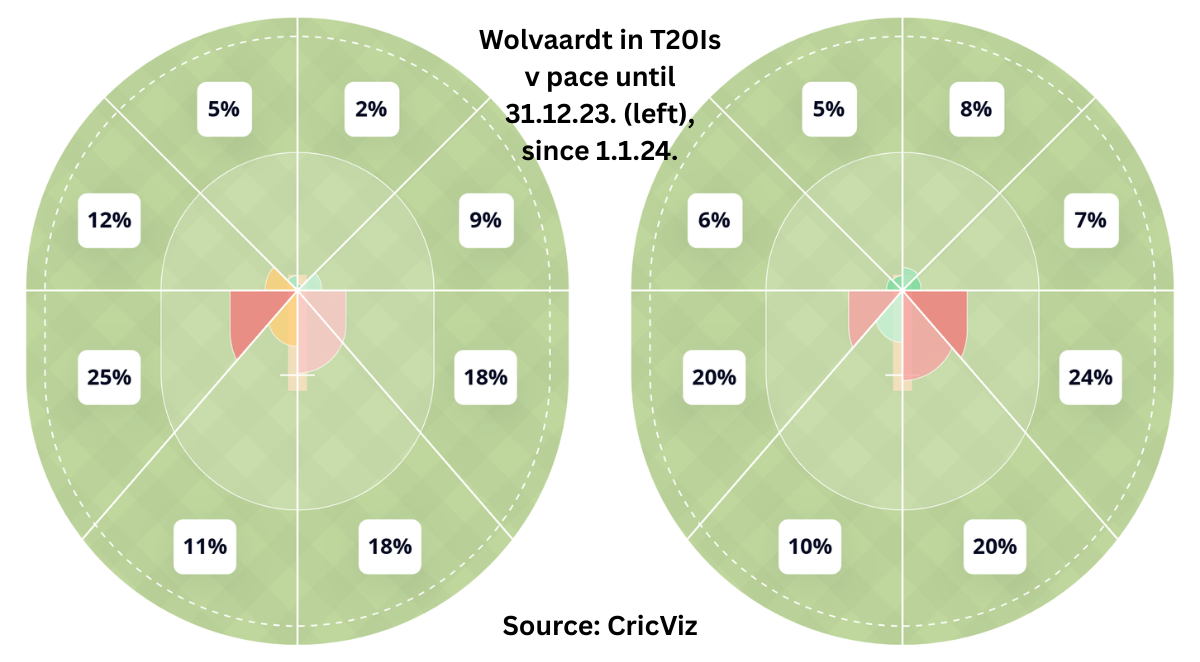
Wolvaardt is now the product of an amalgamation of conventional technique and modern-day power-hitting. She consolidates like an old-school batter (women’s cricket is changing so rapidly that even a decade seems too long) but can also score at a new-gen pace.
The only thing standing between Wolvaardt and that GOAT status is a global title. She came within one match of that in the T20 World Cup in 2023 and 2024, and in the ODI World Cup in 2025. In the latter, she did everything one batter can in a 11-a-side sport.
Perhaps 2026 is her year.